
New drones reduce health and safety risks in deer management

Forestry and Land Scotland (FLS) is employing the latest technology to reduce health and safety risks for its wildlife managers.
The agency has introduce heavy-lift drones to help with deer management.
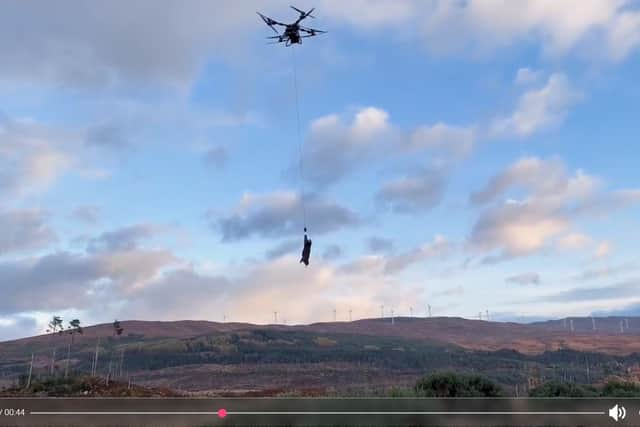

Deer are often culled in difficult and remote terrain but carcasses intended for human consumption have to reach a larder for processing as quickly as possible, and in compliance with food standards legislation and best practise.
This can involve the ranger having to physically manhandle a carcass - over several miles and for several hours - to transfer it to a ground vehicle to then take it on to a larder.
That physical exertion over rough terrain and in all weathers presents potential health and safety hazards.
FLS says that using heavy lift drones to move the carcass eliminates that risk.
Grant Carson, wildlife ranger manager, said: “With our partners, DroneWild, we have successfully demonstrated that this technique saves us time but also significantly reduces the health and safety challenges that foresters and wildlife rangers have to plan for and manage.
“These heavy lift drones obviously have a number of forestry applications, such as taking fencing materials to or away from remote and difficult to access locations, but extracting deer carcasses is a major step forward in promoting the safety of our colleagues in the field.
“The time saved also frees them up to apply their considerable skills to other wildlife priorities in an area.”
The Scottish Government’s CivTech programme (Round 9, 2023), set the challenges of improving the effectiveness of wildlife management and the health and safety of Wildlife Rangers.
Flown in trials by CivTech partner, DroneWild, which is licensed and insured to fly them, the heavy-lift drones are capable of lifting up to 100kg, and can be flown (under licence) beyond line of sight up to two thousand meters from the pilot’s position with a spotter half-way.
Although the drones are fitted with cameras, the spotter gives radio guidance to the pilot and ensures that the load is securely attached before giving the pilot the all clear to lift.
DroneWild Director and drone pilot, Ben Harrower, said: “We have been closely involved with FLS’ exploration of drone technology from the beginning, such as trialling drone mounted thermal imaging cameras to locate deer in the landscape.
“The heavy lift drones are the latest application of this technology to field work.
“The results clearly illustrate that they can reduce costs and carbon, save time and significant effort, and reduce risk while opening up parts of the estate that are otherwise hard to reach.
“We look forward to building on this and developing the work further over the coming months."
The drone trials coincided with FLS’s exploration of the benefits to wildlife of leaving deer waste, additional to gralloch (entrails), in the environment.
The Specific Operational Risk Assessment (SORA) and field trials for the new measures were approved by regulators the Civil Aviation Authority.
Full details of the original CivTech Challenge that led to this work can be found online at www.civtech.scot.