
Shipping Lines - Montrose port’s long-standing trade with the Baltic
Two interesting rather brief reports appeared in the pages of the Review in 1858, writes John Aitken.
The first referred to the decimation of the coastal shipping trade which observed, “The Harbour Traffic – on Monday afternoon (sic) though it is at present stream tides there was not a single vessel at the new shore and only two at the tide harbour. In fact, the railways are gradually, but not less surely, annihilating the coastal shipping trade.”

In the same column there was a report on the launch of a schooner from a Perth shipyard for a Montrose owner. It read “Launch of a Schooner – On Monday afternoon (sic) there was launched from the yard of the Perth New Shipbuilding Company a beautiful clipper schooner named “Mountain Maid” of 100 tons register, 185 tons burthen. The vessel glided into the water in splendid style amid the cheers of the large assemblage. We understand the “Mountain Maid” is owned by a Mr. Grandison of Montrose and is to be employed in the Baltic trade.”
Although much has changed around both ports since, one constant remains – the Baltic trade through Montrose. The traffic has moved mainly to the Lower Baltic and the Swedish Lakes. However, there are still occasional cargoes from other parts of the Gulf of Bothnia region.
Among the few cargo ships in recent weeks was the Dutch-flag Jolyn, a member of the Wagenborg fleet, which arrived from the Swedish port of Halmstad. Built at the Peters shipyard at Kampen in 2007, she was no stranger to the port having been here on several occasions.
A few days later saw the arrival of the Bulgarian-built cargo ship Swe-Freighter which had been completed at Rousse in 2000. Her funnel was painted in Ahlmark Line colours – black with a deep white band with a capital “A” in black on the white band. There was no Swedish port of registry on her stern or Swedish flag flying as she was apparently only chartered. Her port of registry was Limassol, Cyprus and she was classified by the Italian classification authorities (RINA) - typical of today’s international shipping industry.
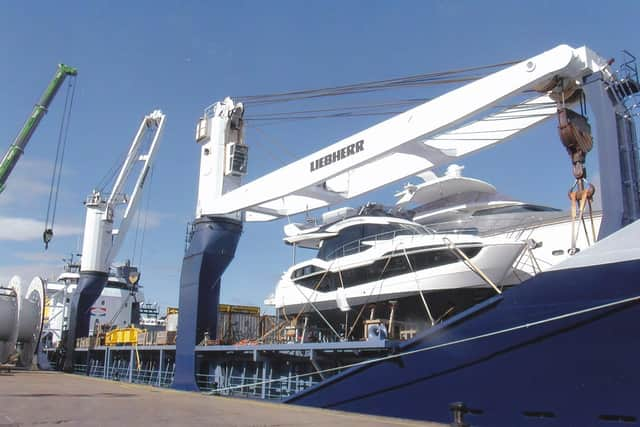
In a relatively short period shipping ranged from the Deo Volente, the Dutch-flag special purpose cargo ship to a modest-sized tug towing a barge to load up with concrete mats. Its owners are a long-established family concern operating a fleet of cargo carriers providing specialised services for a number of maritime sectors including wind generation equipment.
Their main market is the shipping of yachts, having transported over 1250 of these in recent years all around Europe. As it happened, the Deo Volente had several on board during her brief visit to Montrose. Another market in which the company is involved is the transportation of military vehicles and equipment for a number of Western European countries plus the United States.
Ships change names from time to time although it was considered to be unlucky to do so. However, such an event took place at the South Quay recently when the offshore maintenance vessel Edda Brint became the Brint Enabler but still registered at Haugesund.